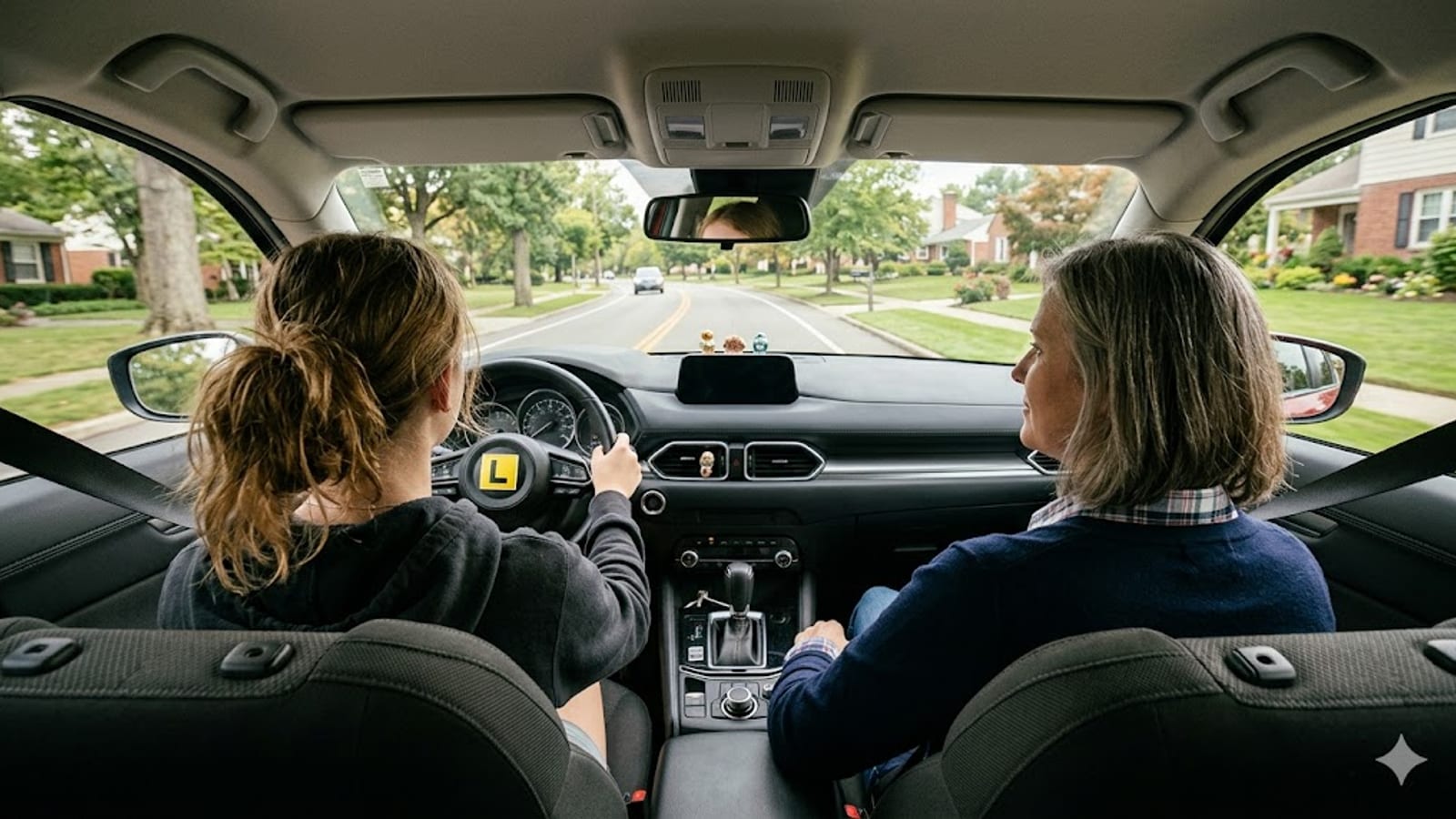
Why 50 Hours? The Case for Lots of Supervised Practice
Most states require dozens of hours of supervised driving before licensure. The number isn't arbitrary — and how you use those hours matters as much as hitting it.
By Drive Smart Academy Team
A common graduated-licensing requirement asks teens to log around 50 hours of supervised driving (often including a set number at night) before they can test for a license. Some families treat it as a box to check. The research suggests it’s better understood as the single most valuable input into a safe driver.
Skill is built, not taught
You can explain how to merge onto a highway in five minutes. Becoming good at it — reading gaps, matching speed, doing it smoothly under pressure — takes repetition. Driving is a perceptual-motor skill, and like any such skill, it improves with deliberate practice across varied conditions.
The supervised-practice requirement exists because crash risk is tied so closely to experience. Hours behind the wheel, accumulated safely with an experienced adult catching mistakes, are how a new driver converts conscious effort into automatic competence.
Why “50” is a floor, not a target
The specific number is a minimum that research and policy converged on as meaningful — but more is generally better, and variety matters as much as volume. Fifty hours of empty-parking-lot loops doesn’t prepare anyone for a rainy highway at night.
Aim to spread practice across the conditions a new driver will actually face:
- Highways and merging
- Night and low-light driving
- Rain, and other reduced-traction conditions
- Heavy traffic and complex intersections
- Parking, backing, and tight maneuvering
- Unfamiliar routes that require navigating while driving
Making practice hours count
- Narrate early, fade later. At first, talk through what you’re noticing (“I’m easing off because that light’s been green a while”). Over time, shift to letting the teen do the noticing.
- Debrief without dwelling. A quick “what would you do differently?” after a tricky moment beats a running critique.
- Stretch deliberately. Each session, add a little complexity — a new road type, a harder time of day — rather than repeating the comfortable.
- Keep a log honestly. The point isn’t the paperwork; it’s making sure the hard conditions actually got covered before the license, not after.
The hours aren’t a bureaucratic hurdle between a teen and a license. They are the safety measure. Used well, they’re where a driver is actually made.
Sources & further reading
Was this helpful?
Thanks — your feedback helps us improve.
Learn to drive the smarter way.
Real-road scenarios, a permit prep that actually sticks, and a parent dashboard that keeps everyone on the same page.
Get early accessKeep reading
Does Driver's Ed Actually Reduce Crashes? What the Research Really Shows
The honest answer is more interesting than yes or no. Decades of research reveal why traditional driver's ed disappointed — and what modern programs do differently.
Research & LearningThe Teenage Brain Behind the Wheel: What Neuroscience Tells Us
Teen driving risk isn't just inexperience — it's developmental. Here's what brain science says about why, and why that's a reason for structure, not despair.
Research & LearningHazard Perception: The Skill That Separates Safe Drivers
Vehicle control is the easy part. The harder, more protective skill is seeing trouble before it happens — and unlike instinct, it can be trained.