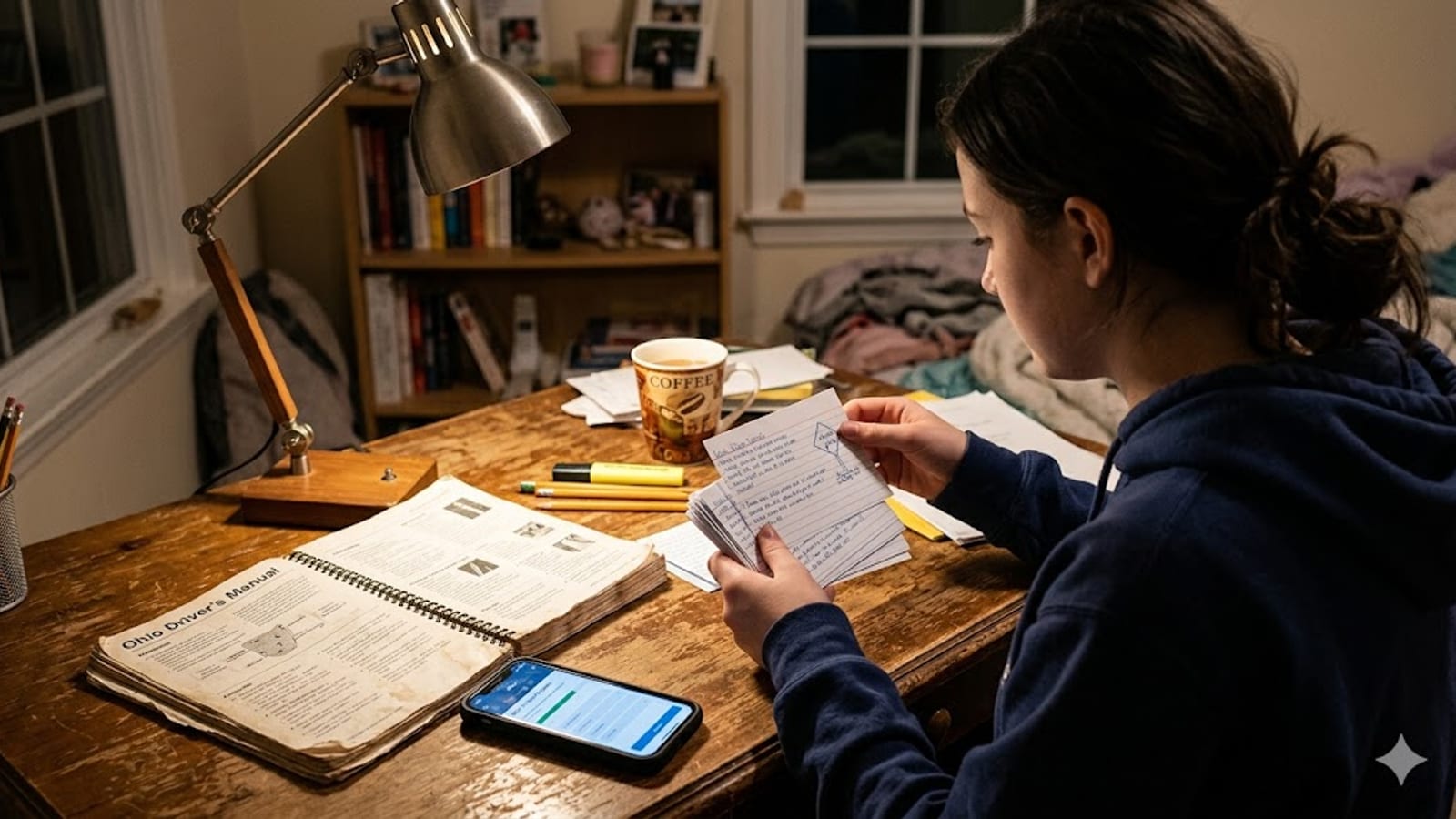
Why Cramming for the Permit Test Backfires
The night-before cram is a tradition for a reason — it sort of works for the test. But it's the worst way to actually learn the rules you'll drive by for life.
By Drive Smart Academy Team
Almost every new driver faces a written knowledge test covering road rules, signs, and safe-driving principles. And almost every new driver is tempted to handle it the same way they handle a history quiz: cram the night before, pass, forget.
For a test, cramming can scrape by. For driving, it’s exactly backwards — because the permit test isn’t really about the test. It’s about loading rules into memory that you’ll rely on, instantly, for the rest of your driving life.
What learning science actually says
Decades of cognitive-psychology research point to two techniques that dramatically outperform cramming for durable learning:
- Spaced repetition. Studying material in shorter sessions spread over days or weeks produces far better long-term retention than the same total time in one block. The forgetting-and-recalling cycle is what cements knowledge.
- Retrieval practice (the testing effect). Actively quizzing yourself — pulling an answer from memory — strengthens it more than re-reading the handbook. The effort of recall is the mechanism, not a side effect.
Cramming feels productive because the material is fresh and fluent in the moment. That fluency is a trap: it fades within days, which is fine for a one-time quiz and disastrous for knowledge you need behind the wheel.
Why it matters for driving specifically
When a yellow light appears or a sign flashes by, there’s no time to reason it out from scratch. The right response has to be retrievable instantly. Knowledge that was crammed and forgotten can’t do that. Knowledge that was spaced and self-tested can.
In other words, the studying method that builds a lasting mental model of the rules is the same one that makes you a safer driver — not just a passing one.
How to study the rules the right way
- Start early, in small doses. Fifteen minutes a day for two weeks beats four hours the night before.
- Quiz, don’t re-read. Use practice questions and flashcards. Answer first, then check.
- Space out the topics you miss. Revisit weak areas after a day, then a few days, then a week.
- Connect rules to reasons. “Why does this sign mean slow down here?” makes the rule stick far better than rote memorization.
Pass the test, yes. But study in a way that means you’ll still know the answer a year later — when it actually counts.
Sources & further reading
Was this helpful?
Thanks — your feedback helps us improve.
Learn to drive the smarter way.
Real-road scenarios, a permit prep that actually sticks, and a parent dashboard that keeps everyone on the same page.
Get early accessKeep reading
Does Driver's Ed Actually Reduce Crashes? What the Research Really Shows
The honest answer is more interesting than yes or no. Decades of research reveal why traditional driver's ed disappointed — and what modern programs do differently.
Research & LearningThe Teenage Brain Behind the Wheel: What Neuroscience Tells Us
Teen driving risk isn't just inexperience — it's developmental. Here's what brain science says about why, and why that's a reason for structure, not despair.
Research & LearningWhy 50 Hours? The Case for Lots of Supervised Practice
Most states require dozens of hours of supervised driving before licensure. The number isn't arbitrary — and how you use those hours matters as much as hitting it.