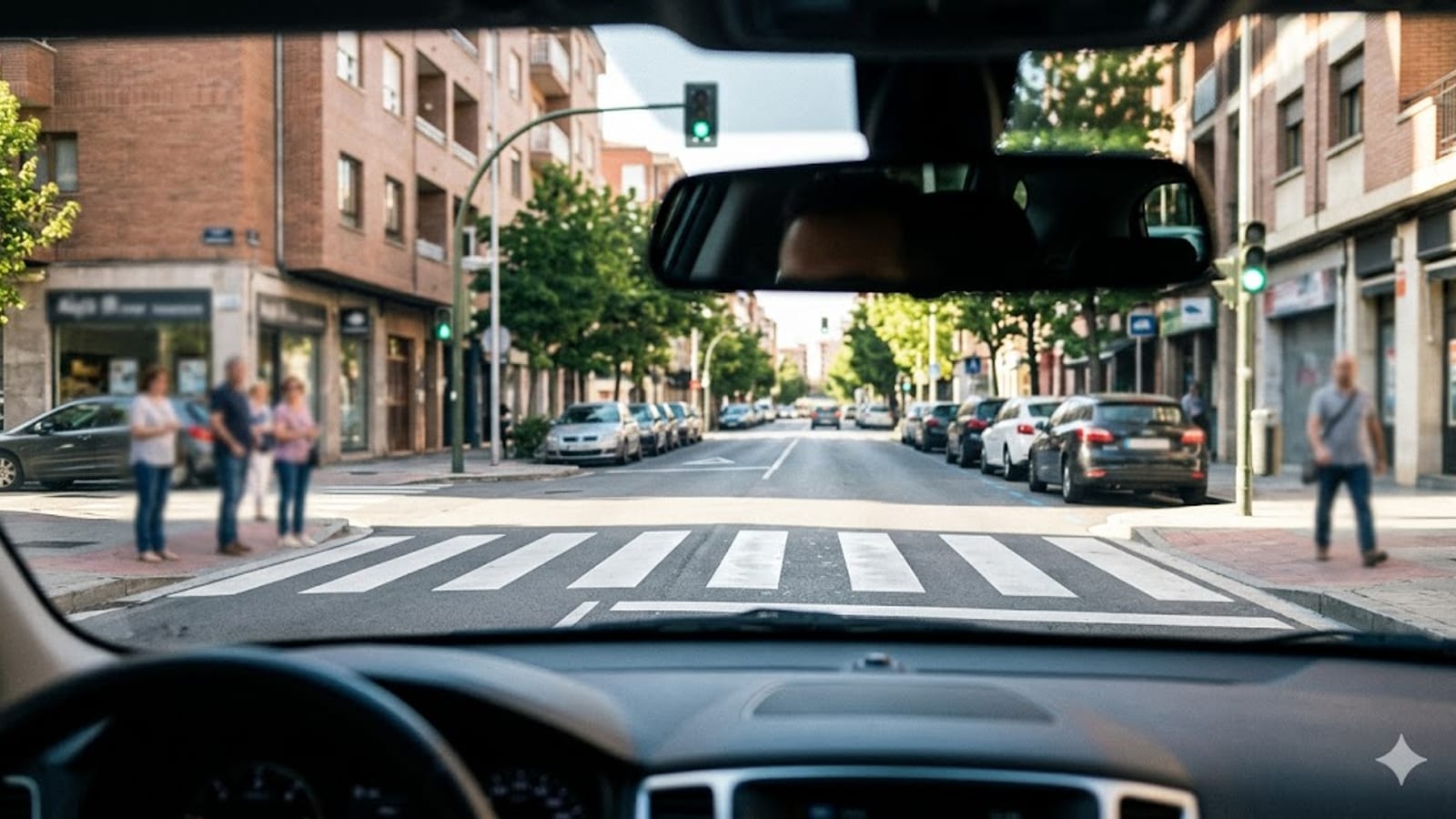
Hazard Perception: The Skill That Separates Safe Drivers
Vehicle control is the easy part. The harder, more protective skill is seeing trouble before it happens — and unlike instinct, it can be trained.
By Drive Smart Academy Team
Ask an experienced driver what makes them safe, and they’ll rarely mention steering or braking. They’ll describe something subtler: a sense for which parked car might pull out, which intersection feels wrong, where a pedestrian might step off the curb. That sense is hazard perception — and it’s one of the few driving skills research has tied directly to lower crash risk.
Why it’s the skill that matters
New drivers spend most of their attention on the mechanics: lane position, pedals, mirrors. That’s appropriate early on, but it leaves little capacity for scanning the wider scene. Experienced drivers have automated the mechanics, freeing attention to look further ahead and ask “what could go wrong here?”
Studies — including work behind the UK’s hazard-perception licensing test — find that drivers who detect developing hazards faster tend to be involved in fewer crashes. Crucially, hazard perception improves with training and practice. It isn’t a fixed trait you’re born with or without.
How developing hazards differ from obvious ones
A child already in the road is a hazard anyone sees. The skill is reading the precursors:
- A ball rolling into the street (a child may follow)
- Brake lights several cars ahead (traffic is about to bunch)
- A bus stopped at the curb (pedestrians may cross in front of it)
- A car drifting in its lane (the driver may be distracted)
Good drivers are constantly running these “if-then” predictions, slowing or repositioning before the hazard fully materializes.
How to build it deliberately
- Practice commentary driving. Have the new driver narrate what they’re watching and why: “Watching that driveway — car looks like it’s about to back out.” Speaking the scan out loud makes the invisible visible and trains the habit.
- Use scenario-based practice. Reviewing realistic situations — and deciding what you’d do before the moment arrives — builds the prediction reflex without the risk of learning it the hard way.
- Look far, not near. New drivers fixate close to the hood. Coaching the eyes to lift and scan the horizon, mirrors, and sides widens the field of awareness.
- Ask “what’s the worst that could happen here?” Routinely, at intersections and crosswalks, until it becomes automatic.
Vehicle control gets a new driver moving. Hazard perception is what keeps them out of trouble — and it’s eminently teachable.
Sources & further reading
Was this helpful?
Thanks — your feedback helps us improve.
Learn to drive the smarter way.
Real-road scenarios, a permit prep that actually sticks, and a parent dashboard that keeps everyone on the same page.
Get early accessKeep reading
Does Driver's Ed Actually Reduce Crashes? What the Research Really Shows
The honest answer is more interesting than yes or no. Decades of research reveal why traditional driver's ed disappointed — and what modern programs do differently.
Research & LearningThe Teenage Brain Behind the Wheel: What Neuroscience Tells Us
Teen driving risk isn't just inexperience — it's developmental. Here's what brain science says about why, and why that's a reason for structure, not despair.
Research & LearningWhy 50 Hours? The Case for Lots of Supervised Practice
Most states require dozens of hours of supervised driving before licensure. The number isn't arbitrary — and how you use those hours matters as much as hitting it.