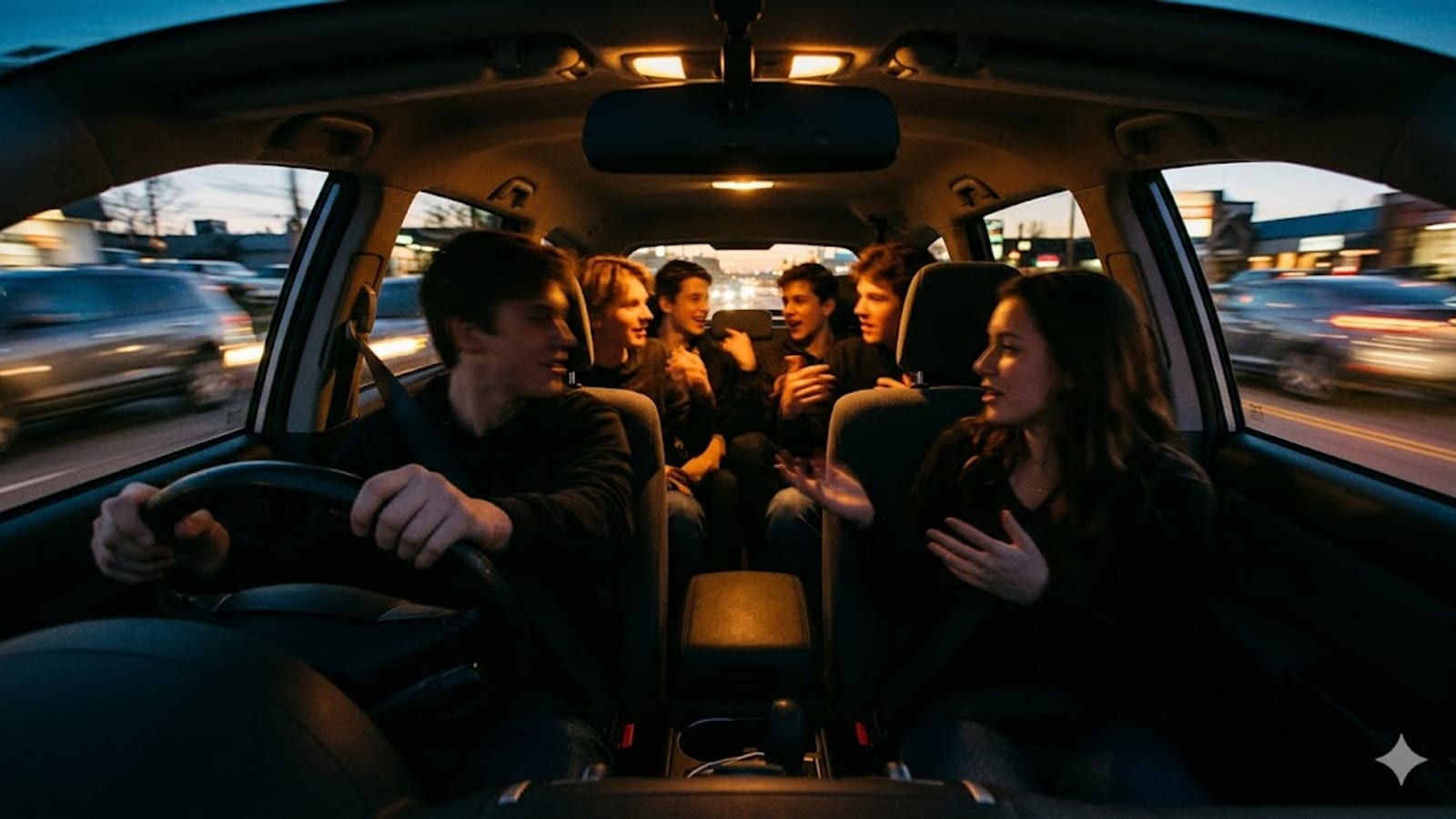
How a Carful of Friends Changes a Teen's Crash Risk
One of the best-documented findings in teen-driving research: each additional young passenger raises crash risk. Here's the why behind passenger restrictions.
By Drive Smart Academy Team
Of all the findings in teen-driving research, few are as consistent as this one: for a young driver, the risk of a fatal crash rises with each additional teen passenger — and it climbs steeply. Research from the AAA Foundation for Traffic Safety and IIHS has shown the effect across decades and datasets.
It’s the reason almost every graduated-licensing program limits how many young passengers a new driver can carry.
Why passengers raise risk
A car full of peers changes the driving environment in a few ways:
- Cognitive load. Conversation, music, and activity all compete for attention that a new driver needs for the road.
- Social pressure. Showing off, egging each other on, or simply not wanting to look overly cautious can nudge a young driver toward riskier choices — often without anyone intending it.
- Distraction events. A dropped phone, a sudden reaction, or horseplay in the back seat can pull a driver’s focus at exactly the wrong moment.
Notably, the pattern differs by passenger. Research suggests that an adult passenger tends to lower a teen’s crash risk, while teen passengers raise it. Supervision calms; peers amplify.
What the restrictions actually say
The specifics vary by state, but a common GDL rule is something like: no more than one non-family passenger under a certain age during the first 6–12 months of licensure. Some states tighten this further for nighttime.
These limits aren’t arbitrary. They target the exact conditions the data flags as most dangerous, during the exact window when new drivers are most vulnerable.
How families can use this
- Treat the passenger limit as a family rule, not just a law. It’s one of the highest-leverage safety habits available.
- Have the conversation in advance. A teen who’s already decided how they’ll handle “can you give us all a ride?” is far better positioned than one improvising under social pressure.
- Make the no easy. “My parents won’t let me until next year” is an entirely acceptable — and face-saving — answer.
The point isn’t to keep friends apart. It’s to give a new driver the first months of experience without the added load that the evidence consistently flags as risky.
Sources & further reading
Was this helpful?
Thanks — your feedback helps us improve.
Learn to drive the smarter way.
Real-road scenarios, a permit prep that actually sticks, and a parent dashboard that keeps everyone on the same page.
Get early accessKeep reading
The "100 Deadliest Days": Why Summer Is the Riskiest Season for Teen Drivers
Between Memorial Day and Labor Day, teen-involved crashes climb sharply. Here's why summer is so dangerous for new drivers — and what families can do about it.
Safety & TrendsDistracted Driving and the Smartphone Generation: What the Data Says
Phones are the most visible driving distraction, but they aren't the only one. Here's how distraction causes crashes and what genuinely reduces it for new drivers.
Safety & TrendsWhy the First Year of Solo Driving Is the Most Dangerous
Crash risk for new drivers is highest in the first months after licensure, then falls fast. Understanding why points to exactly where families should focus.